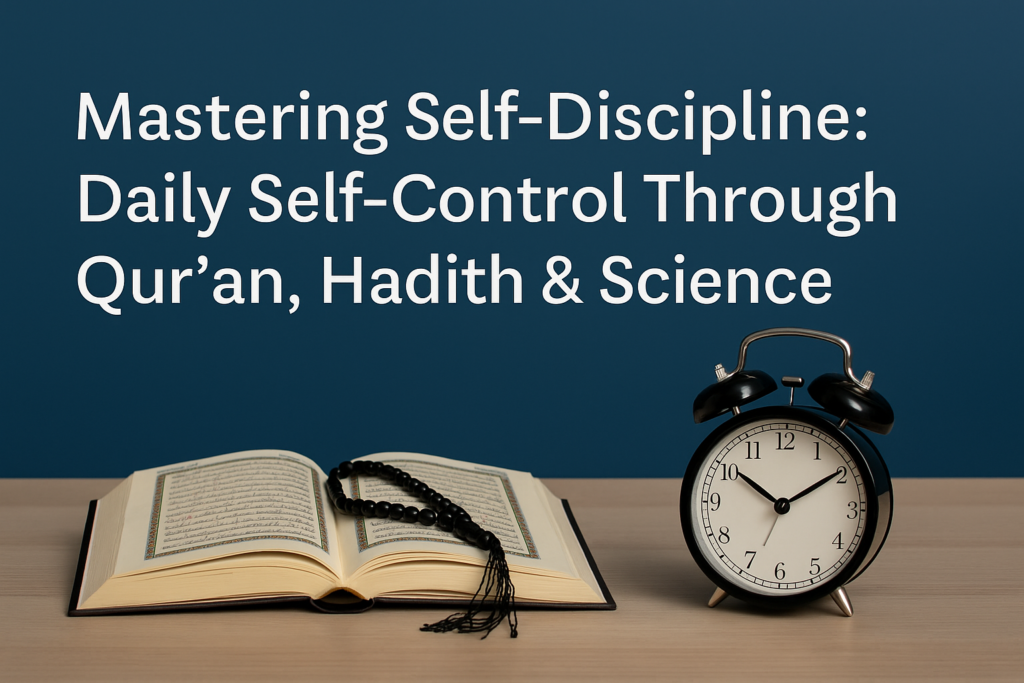
Self-discipline is the art of controlling your inner self — your nafs — in a world full of distractions and desires. Islam not only commands self-control but also provides a proven daily system for building it. Interestingly, modern science has confirmed many of these timeless teachings.
Let’s explore how the Qur’an, authentic Hadith from Sahih Bukhari, and science guide us toward building a routine of inner strength and consistent discipline.
🍽️ 1. Eat with Moderation — Don’t Fill the Stomach
Hadith:
“A believer eats in one intestine (is satisfied with a little food), and a disbeliever eats in seven intestines (eats much).”
— Sahih al-Bukhari, Hadith 5397
✅ Islamic Tip:
- Follow the 1/3 rule: for food, water, and air.
- Avoid eating until you’re full.
🔬 Scientific Insight:
Eating moderately improves digestion, supports brain performance, and reduces the risk of chronic diseases. Studies show that overeating weakens cognitive control and increases fatigue.
💡 Eat less, think more, worship better.
🌅 2. Sleep Early & Wake Up for Fajr
Hadith:
“O Allah, bless my nation in their early mornings.”
— Sahih al-Bukhari, Hadith 2757
✅ Islamic Tip:
- Sleep soon after Isha.
- Wake up before or at Fajr for Qur’an, reflection, or planning.
🔬 Scientific Insight:
The body’s deepest recovery sleep occurs before midnight. Early risers have stronger decision-making skills, improved moods, and better memory retention.
💡 The Prophet’s ﷺ routine matches the healthiest sleep patterns today.
🤲 3. Tasbih After Fajr & Asr: A Discipline Tool
Hadith:
“Whoever says, ‘SubhanAllahi wa bihamdihi, SubhanAllahil Azeem’ 100 times a day, his sins will be forgiven even if they are as much as the foam of the sea.”
— Sahih al-Bukhari, Hadith 6405
✅ Your Zikr Habit:
- Recite this after Fajr and Asr, as you already do.
- Use a tasbih or app to track and focus.
🔬 Scientific Insight:
Repetitive, meaningful phrases (like tasbih) activate the parasympathetic nervous system, reducing stress and promoting emotional regulation — much like mindfulness meditation.
💡 Dhikr = calm heart + purified soul.
🗣️ 4. Speak Less, Speak with Purpose
Qur’an (Surah Qaf, 50:18):
“Not a word does he utter but that there is an observer ready to record it.”
✅ Islamic Tip:
- Speak only when it benefits. Avoid idle talk and backbiting.
🔬 Scientific Insight:
Speech affects energy. Excess talking drains mental focus and impulsive speech leads to regret. Neuroscience shows that thoughtful communication improves emotional intelligence.
💡 Silent minds are sharper minds.
💭 5. Resist Desires – Train Your Nafs
Qur’an (Surah An-Nazi’at, 79:40–41):
“But as for he who feared standing before his Lord and restrained the soul from [its] desire, then indeed, Paradise will be [his] refuge.”
✅ Islamic Tip:
- Monitor urges (scrolling, junk food, anger).
- Replace with Qur’an, skills, or community service.
🔬 Scientific Insight:
Willpower strengthens with use. Studies on self-regulation show that people who regularly resist small temptations build more long-term success and peace.
💡 Your daily self-control is your Jannah training.
🎯 6. Set Daily Goals — With Intention (Niyyah)
Qur’an (Surah Al-Hujurat, 49:13):
“Indeed, the most noble of you in the sight of Allah is the most righteous of you…”
✅ Islamic Tip:
- Set 2–3 meaningful goals after Fajr.
- Attach niyyah to turn effort into reward.
🔬 Scientific Insight:
Writing goals improves focus by 42% (Dominican University study). When goals are tied to values or beliefs, motivation significantly increases.
💡 Intentional routines are more likely to last.
📆 7. Weekly Self-Review — Accountability First
Qur’an (Surah Al-Hashr, 59:18):
“O you who have believed, fear Allah. And let every soul look to what it has put forth for tomorrow.”
✅ Reflection Habit:
- Review your progress every Friday/Saturday:
- What went well?
- Where did I lose control?
- What’s one change for next week?
🔬 Scientific Insight:
Weekly self-checks increase personal productivity and help the brain form better planning and memory habits.
💡 Self-awareness is the core of self-discipline.
🌟 Final Reminder: Small Steps, Regularly Done
Hadith:
“The most beloved actions to Allah are those which are done regularly, even if they are small.”
— Sahih al-Bukhari, Hadith 6464
Success isn’t in huge changes — it’s in small consistent habits done daily with sincerity. Whether it’s your tasbih after Asr, your meal control, or your early sleep — each step is a seed for a better akhirah.